Coastal Southern California microclimates foster extended stinging insect seasons, stretching from early March through late November. The UC Statewide our team documents that the Western…
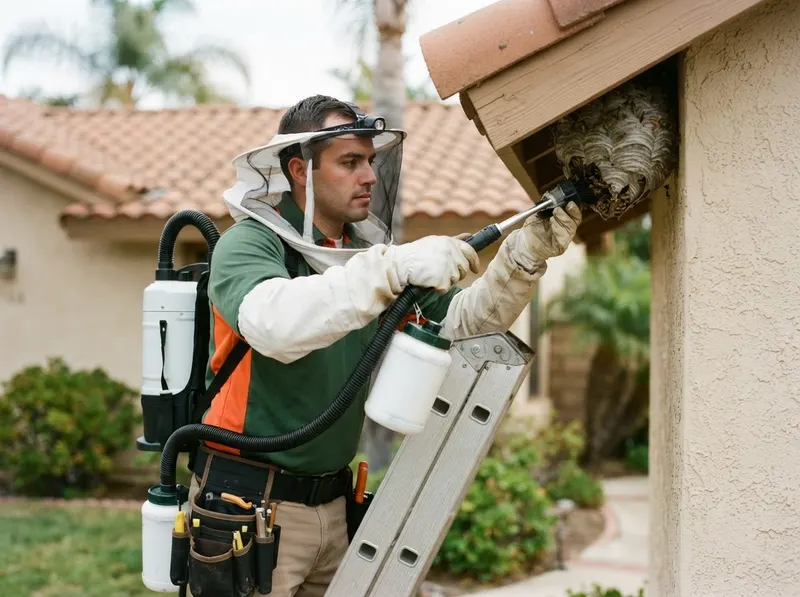
Coastal Southern California microclimates foster extended stinging insect seasons, stretching from early March through late November. The UC Statewide Integrated Pest Management Program documents that the Western yellowjacket (*Vespula pensylvanica*) frequently establishes subterranean nests housing 1,000 to 5,000 workers in dry residential soils, often near landscaped parkways in Mission Hills, Carmel Valley, and Scripps Ranch. Aerial paper wasps (*Polistes dominula*) prefer nesting beneath open architectural eaves, wooden pergolas, and coastal deck beams common throughout Point Loma, Pacific Beach, and Ocean Beach. EcoGuard Extermination applies EPA Integrated Pest Management standards to mechanically isolate and remove active colonies without spraying synthetic organophosphates or broad-spectrum neonicotinoids near outdoor living zones.
Ground colonies situated in garden beds or lawn edges pose high sting risks during routine mowing, while structural infestations beneath fascia boards can puncture drywall into home interiors. Field protocols follow worker protection guidelines set by the OSHA Personal Protective Equipment Standard, requiring technicians to wear multi-layered canvas bee suits with sealed veil closures and full-face respirators. According to the NIOSH stinging insects safety index, multiple stings from defensive yellowjackets present severe allergic hazards; non-chemical extraction relies on pressurized HEPA-filtered vacuum interception followed by physical excavation of underground comb structures.
EcoGuard Extermination uses certified bio-based plant oils, including wintergreen, rosemary, and thyme extracts registered under California Department of Pesticide Regulation guidelines, to break down protective pheromone scent trails without leaving synthetic residues that harm neighborhood runoff or the coastal watershed overseen by the City of San Diego Stormwater Department. Non-target beneficial native pollinators receive full protection in accordance with conservation directives from the U.S. Fish and Wildlife Service Pollinator Portal and pollinator preservation strategies outlined by the Xerces Society for Invertebrate Conservation. If an active colony is identified as a vital honeybee hive rather than an aggressive yellowjacket nest, extraction transitions directly to non-lethal relocation protocols recognized by the San Diego County Department of Agriculture, Weights and Measures Bee Program. Technicians seal all architectural gaps using copper mesh and weather-resistant silicone meeting ASTM C920 sealant specifications to stop seasonal re-nesting.
Every job gets a firm, written price after a free on-site visit.
For standards, safe disposal, and service guidance on pest control services in San Diego, CA, useful references include U.S. EPA, ENERGY STAR, U.S. Dept. of Energy, Consumer.gov, U.S. Census Bureau, and Google Maps. General consumer and small-business resources are available from USA.gov, Better Business Bureau, FTC Consumer Advice, U.S. Small Business Administration, and Ready.gov.
Tell us about your humane wasp and yellowjacket nest removal job in San Diego and we'll send a clear, written quote, usually the same day.
 EcoGuard Extermination